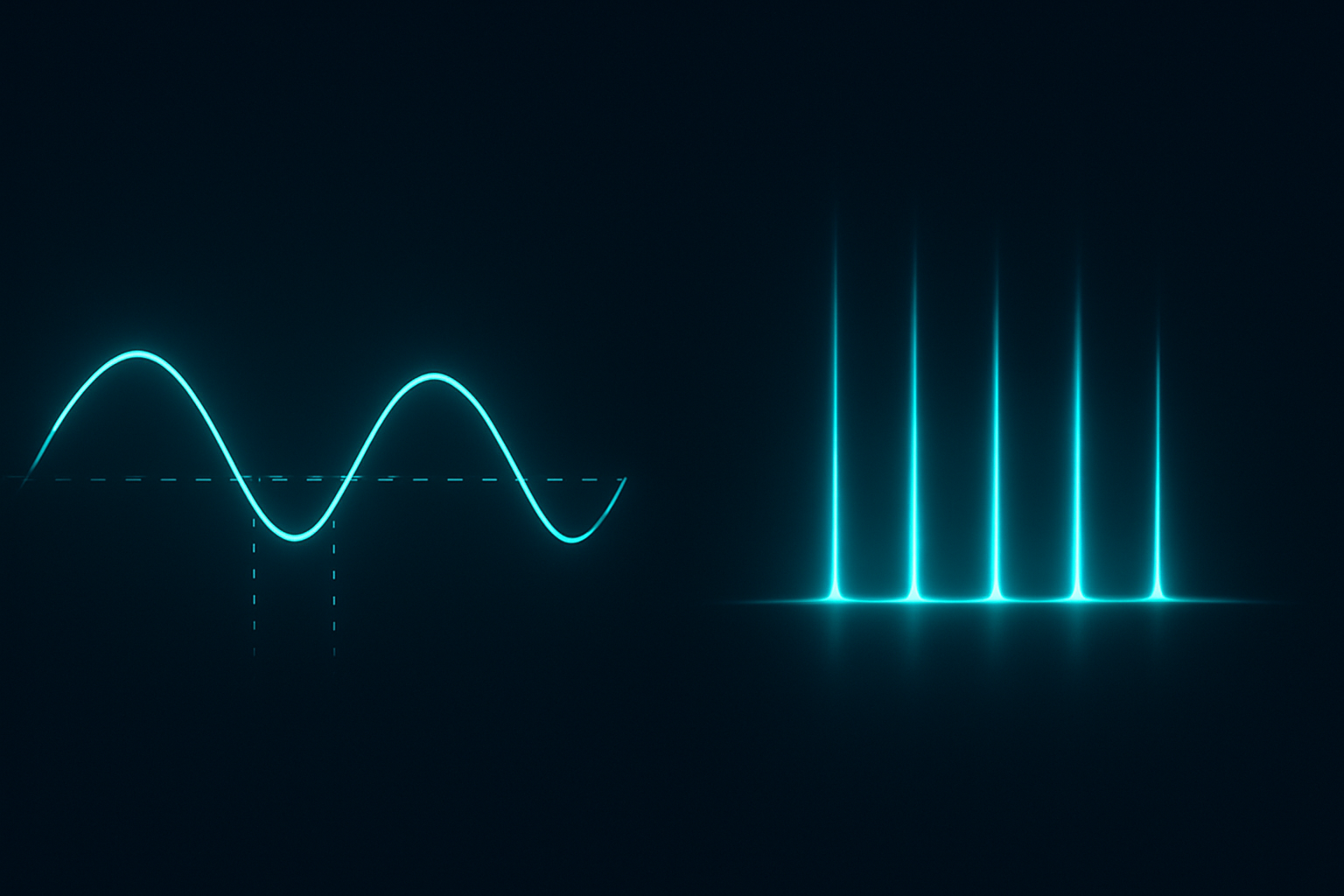
Indirect ToF measures the phase shift of a modulated light source; direct ToF times individual photons with SPADs. The physics sounds academic, but the practical differences decide which sensor belongs in your product. Here's the honest comparison, across our own lineup.
Resolution: iToF wins
Indirect ToF packs far more measurement points into the same die, which is why Spatial Vision delivers 320 × 240 depth — enough for gesture recognition and people analytics, where you need to resolve fingers and separate individuals.
Sunlight: dToF wins
Direct ToF's photon timing rejects ambient light far better, so Spatial Robot ranges a full 8 m outdoors where an indirect sensor washes out. For anything that goes outside or near skylights — AMRs, drones, dock doors — this is the deciding factor.
Integration: all-in-one iToF
Some indirect ToF modules do the depth processing on-module. Spatial Home outputs a 100 × 100 room-scale depth map with zero host-side pipeline — you read distances, not raw phase data. For a product team that doesn't want to build a depth pipeline, that's the fastest path to shipping.
Power: single-zone dToF
A single-zone dToF sensor idles in microamps, which makes Spatial Mini the only sensible choice for battery-powered products — smart locks, presence detectors, anything that has to run for months on a coin cell.
Rule of thumb
- Interaction (gesture, people) → iToF, Spatial Vision
- Navigation (outdoor, ranging) → dToF, Spatial Robot
- Drop-in simplicity (room sensing) → all-in-one iToF, Spatial Home
- Battery (presence, locks) → single-zone dToF, Spatial Mini
And because all four run the same SpatialAI SDK, a wrong first guess costs you a purchase order, not a rewrite — swap the sensor, keep the code.
Compare the full depth lineup side by side on the products page, or buy a dev unit to try one.